
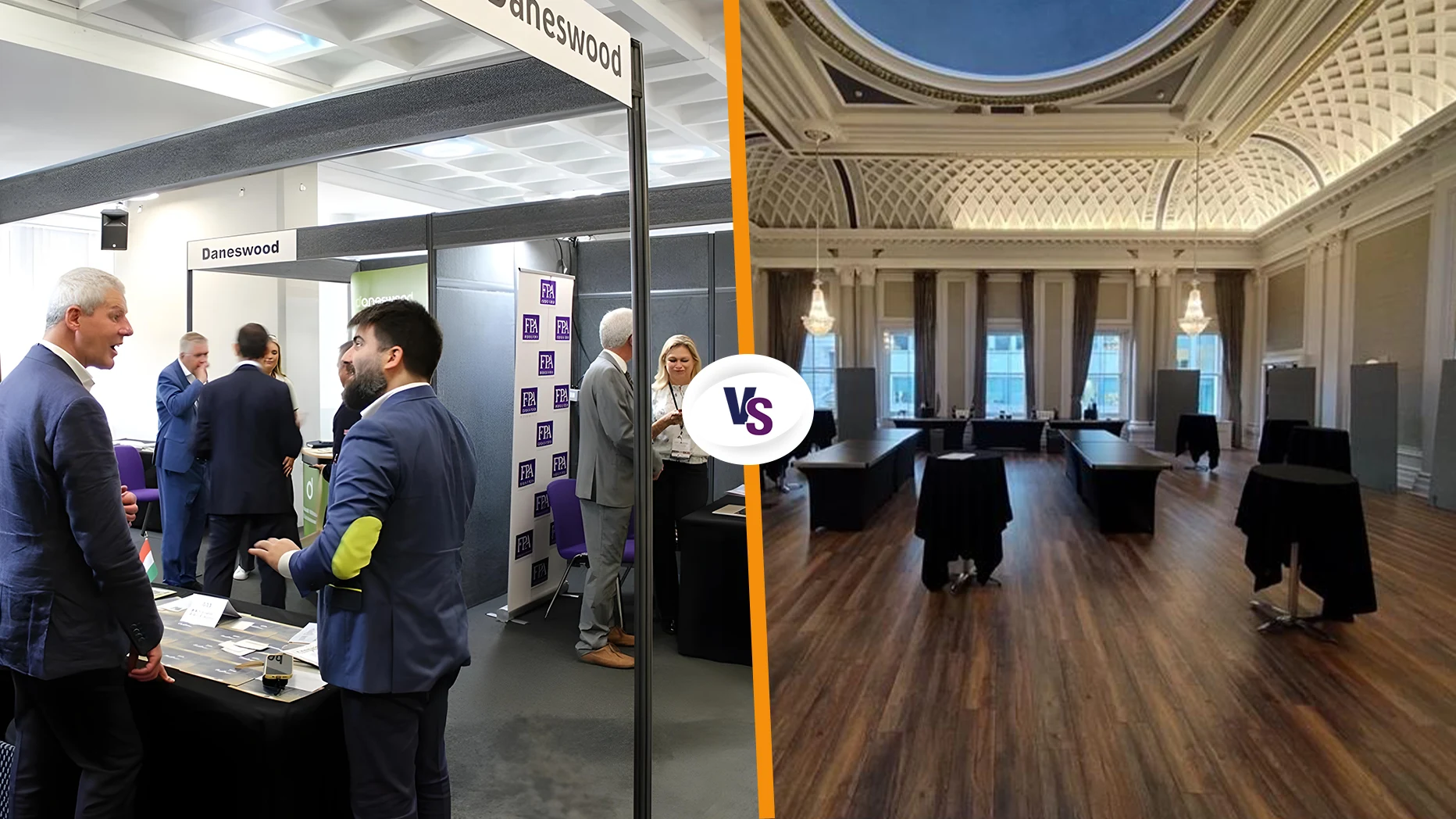
B2C event marketing ideas aim for emotion, speed, and shareability (pop-ups, festivals, product trials), while B2B event marketing ideas focus on credibility, depth, and the pipeline (talks, demos, scheduled meetings). The smartest teams adapt their event marketing to how their audience actually decides to buy, not just what looks good on a mood board.
Put a street food festival and a manufacturing trade show side by side and on paper, they look similar because for both events, space is hired, stands are built, AV is wired, and staff are briefed.
But the way marketing needs to work in those two rooms could not be more different. One is trying to make people say, “That looks fun, let’s go in.” The other is trying to make someone say, “Let’s book a meeting next week.”
In fact, recent research shows 77% of marketers say events are their most effective channel, and 78% of organisers call in-person events their most impactful marketing activity.
Understanding the difference between B2C vs B2B is what turns event marketing ideas from noise into results.
The Core Difference Between B2C And B2B Event Marketing
B2C events chase volume and emotion, while B2B events chase qualified conversations and long-term deals. Here’s a core difference at a glance:
| Aspect | B2C Events | B2B Events |
| Main goal | Immediate sales, brand love, buzz | Qualified leads, meetings, pipeline |
| Audience | Large, mixed, general public, consumers | Narrow, job-specific professionals, senior buyers and influencers. |
| Decision speed | Minutes to days, fast, emotional, often on the spot | Weeks to months, slow, rational |
| Tone | Emotional, playful, sensory | Informative, consultative, expert |
| Hero ideas | Pop-ups, trials, social moments | Talks, demos, private meetings |
| Success looks like | Footfall, social shares, on-site sales, | Leads, meetings, opportunities, pipelines, contracts, and revenue influence |
| Ideal space | Open, inviting, eye-catching | Structured, zoned, meeting-friendly |
That’s why a glitter Instagram wall can work brilliantly at a consumer lifestyle show and fall completely flat at an engineering congress where the buyer just wants a quiet area, a space sheet and a decision-making conversation.
Live events still matter to both worlds. A recent study shows that 68% of B2B marketers say live events generate their most valuable leads. And up to 85% of consumers are more likely to buy after a branded experience.
B2C Event Marketing Ideas To Attract Consumers
For B2C, the ideas that work are visceral, visible and easy to join; people should understand the invite from ten metres away.
Experiential Pop-Ups and Brand Installations
Give people something to feel, and they will remember it long after they have forgotten your ad.
Pop-ups, street installations, festival activations, and shopping centre takeovers work well when they are:
- Simple to grasp: “Taste this”, “Try this”, Win this”, “Step inside”.
- Visually strong: Bold structures, clear branding, photo-friendly angles.
- Easy to share: Obvious spots for photos or short videos.
Social-First Consumer Events
If it does not look good on a phone screen, most B2C visitors will walk past it. For consumers’ events, you are designing for two audiences: the people at the show and the people watching them on social.
Useful ideas:
- Branded AR filters, lightboxes, or LED backdrops.
- Live content walls showing tagged posts.
- “Do something” moments: mini-challenges, spin-to-win, quick games.
| Did you know? 98% of attendees create social or digital content at experiences and events, and most of them share it. |
That turns one good idea into days of extra reach.
Product Trial Zones At Public Shows And Festivals
Let people try it, then buy it. Don’t overcomplicate it.
Most consumer events live or die in the first three seconds. A visitor glances across the aisle and thinks either “that looks fun/interesting/useful” or “not for me”. So, product trial zones at public shows and festivals need to be simple, visible and emotionally clear.
That’s why tasting counters, playable demos, selfie corners, mini stages and “step inside” are the best experiences at public shows and festivals. They’re not complicated strategies; they’re clean invitations. Taste this. Try that. Win something. Look inside.
These work best when supported by clear signage, sturdy counters, and simple AV: screens showing how it works, short looping videos, and punchy benefits. Many brands lean on full-service exhibition contractors and event hire companies in the UK, like EMS Exhibitions, to supply the shells, counters, display boards and AV that make this practical at scale.
B2B Event Marketing Ideas That Move The Pipeline
In B2B, the best marketing ideas help buyers learn faster, trust sooner, and decide with less risk.
Thought Leadership At Conferences And Trade Shows
If you want serious buyers, show them quick decision-making thinking. Strong B2B event marketing often centres on:
- Conference talks that answer real problems.
- Panel discussions with customers, not just your own team.
- Live case study sessions with numbers, not slogans.
B2B attendees still rank in-person events as one of the most valuable ways to learn about new products and services. So use events to teach, not just pitch.
Appointment-Led Trade Show Stands
Don’t just “hope for traffic”. Design for meetings, too.
Instead of waiting for a chance encounter:
- Pre-book meetings with key prospects.
- Offer private demo slots.
- Build small meeting pods into your stand.
When a single B2B lead can cost a few hundred pounds to acquire, every booked meeting is serious money. A stand laid out with clear demo areas and quiet seating will always outperform a random open box.
Executive Briefings, Roundtables And VIP Dinners
Sometimes the best “marketing idea” is a well-run conversation over a table.
For senior buyers, low-noise, high-trust formats work:
- Invite-only roundtables on niche topics.
- Small executive briefings around a conference.
- Private dinners with a handful of carefully chosen guests.
This is where practical things like good furniture, lighting and AV suddenly become strategic. It’s hard to build trust when the mic keeps cutting out.
Marketing Ideas That Work In Both B2C And B2B Events
Some ideas travel well between audiences; you just change the tone, not the tool.
Live Demos With Strong Visual Support
People believe what they can see, not just what they are told.
Whether you are selling smartphones to consumers or software to CFOs, live demos backed by clear visuals on screens or LED walls are incredibly effective.
- For B2C: Show the transformation before/after the camera resolution, show them the original look, side-by-side comparison with other smartphones.
- For B2B: Show the workflow, dashboard, savings, or time saved.
Hybrid Content: Use the Event Twice
If the idea is good enough to run live, it’s probably good enough to repurpose. Record:
- Talks and panels (for future webinars or YouTube).
- Demos (for sales decks and product pages).
- Visitor questions (for FAQs and content ideas).
This works for B2C and B2B. You just publish in different places. One event, multiple assets.
How Event Infrastructure Changes Your Marketing Options?
Brilliant ideas die in bad spaces. The physical build decides what’s actually possible. Every event marketer has met the same problem: great idea, poor stand.
The basics matter:
- Shell schemes give you structure, power, lighting, and safe walls to brand.
- Display boards let you quickly zone, content, galleries, or info points.
- Furniture and AV decide whether people linger or escape.
Full-service exhibition partners in London, such as EMS Exhibitions, support organisers with shell scheme hire, display board hire, exhibition stands, furniture and AV for trade shows and events across the UK.
That kind of backbone lets the marketing team focus on content and audience, not tape measures and plug sockets.
How to Choose the Right Event Marketing Ideas for Your Audience?
Start with how your buyer thinks, not with what you saw on LinkedIn last week. A useful question here is: what does “progress” look like for this person at this event? For a consumer at a public show, progress might be:
- Trying something new.
- Signing up for an offer.
- Buying on the spot.
- Sharing a moment online.
For a B2B visitor, progress might be:
- Understanding a complex offer more clearly.
- Agreeing to a follow-up meeting.
- Bringing a colleague over to see a demo.
- Shortlisting you instead of a competitor.
A simple filter to pick the right marketing idea:
- Who are they?
- Families, students, festival-goers, or CTOs, buyers, directors?
- What do they need from the event?
- B2C: fun, novelty, a deal, a story to tell.
- B2B: clarity, proof, reassurance, a way to de-risk a decision.
- Where do they talk about it afterwards?
- B2C: Instagram, TikTok, WhatsApp.
- B2B: LinkedIn, internal reports, team chats.
- How long is the decision cycle?
- B2C: minutes to days.
- B2B: weeks to months.
Once that’s clear, the ideas almost choose themselves. If you need quick decisions and shareable stories, build something visual, playful and easy to join. If you need thoughtful decisions and internal consensus, build something calm, well-explained and easy to revisit later via content or follow-up.
A good rule of thumb: if your idea flatters your creativity more than it helps your audience decide, it probably belongs in a pitch deck, not on a show floor.
Measuring B2C And B2B Event Ideas On Their Own Terms
You can’t judge a festival and a boardroom roadshow with the same scorecard; the numbers that matter are different.
For B2C events, useful measures include:
- How many people came in, and how long did they stayed?
- How many samples, trials or sign-ups were completed?
- What happened to sales in the days or weeks after the event?
- How much social conversation or content does the event generate?
For B2B events, you’re looking more at:
- How many genuinely qualified contacts did you leave with?
- How many meetings were booked or held during the event?
- How much pipeline and revenue can later be traced back to those contacts?
- How much useful content was created for sales and marketing teams to reuse?
Plenty of marketers now say events are their strongest channel. The difference between “we think it went well” and “we know it worked” usually comes down to whether measurement was planned before the stand was built. That’s why many teams now combine good creative ideas with structured setups and digital lead capture, an area where experienced exhibition partners add a lot of quiet value.