
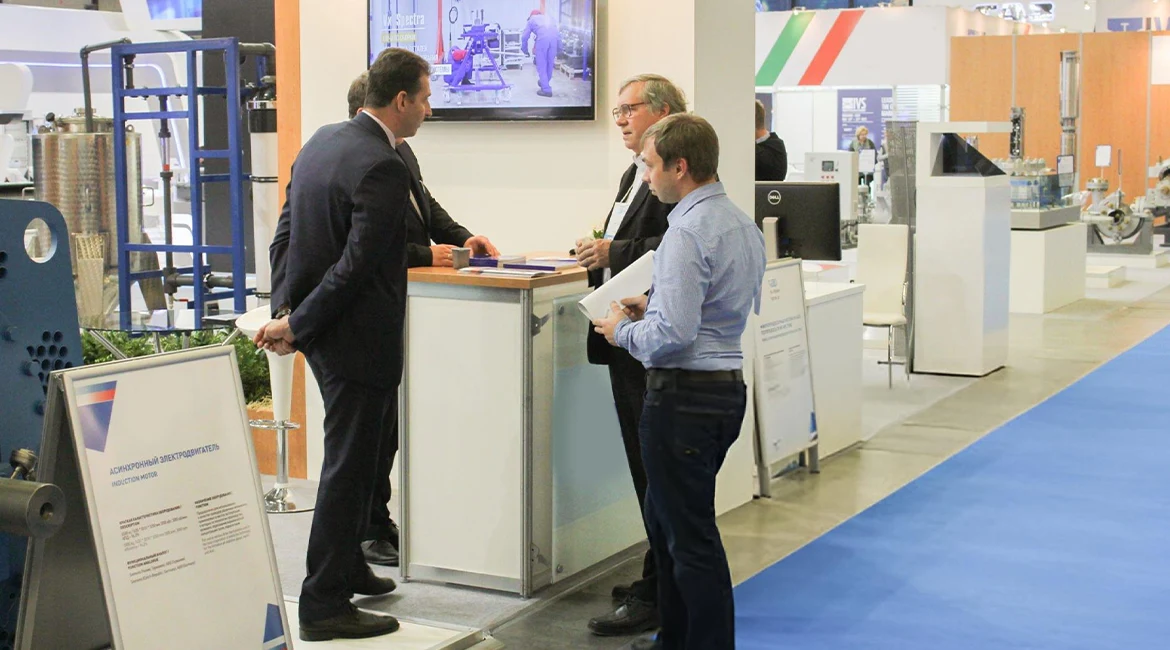
In 2026, exhibit managers aren’t just organising stand builds; they’re managing hybrid journeys, digital engagement, sustainability requirements and hard ROI metrics. So, success depends on smart stand design, integrated tech, reliable partners and protecting their own capacity as much as the budget.
You’re not “booking a stand” anymore. You’re running a mini campaign, a content studio, a hospitality space, and a data project… all squeezed into a few square metres and three show days.
Heading into 2026, the pressure hasn’t eased. The global events industry is still on an upward curve, valued at roughly £1.1 trillion ($1.48 trillion) in 2025 and forecast to more than double by 2033 with strong growth from 2026 onwards.But expectations have grown even faster. Leadership wants clearer ROI. Marketing wants content on tap. Attendees expect smooth, personalised journeys. Venues want proof of sustainability.
And you’re the one holding the floor plan.
This guide pulls together the essential insights for exhibit managers who want 2026 to feel planned, not reactive.
What’s Really Changed For Exhibit Managers In 2026?
2026 turns exhibit managers into mini CMOs; you’re expected to combine live experience, digital touchpoints, AI-driven tools, sustainability, and measurement in a single, joined-up plan. A few big shifts define 2026:
- AI and event tech are now built-in, not “nice to have”
The global event management software market is expected to grow at a double-digit CAGR through 2030, driven by AI personalisation, automation and data analytics.
- Hybrid Is Baked into the Strategy
Industry trend reports for 2026 highlight hybrid as the default: virtual and in-person working together, with budget lines and attendee journeys designed accordingly.
- Sustainability has a standard: ISO 20121:2024
Updated event sustainability guidance (ISO 20121:2024) pushes organisers to prove they’re managing social, environmental and economic impact across the whole event lifecycle.
- Burnout is on the table, not under it
Recent industry surveys show over 70% of event professionals report poor mental health linked directly to their work, with more than half seeing increased burnout and stress in the last year.
You’re not just “doing the stand”. You’re running a live, multi-channel experience inside an industry that’s getting sharper every year.
Insight 1 – Design For Dwell Time, Not Just Footfall
In 2026, the win is not a busy aisle; it’s a stand where the right people stay long enough to talk, try and decide.
Attendees still skim past dozens of stands between coffee and the first keynote. Exhibition research and venue data show that dwell time is a stronger predictor of lead quality and buying intent than raw traffic. People who stay longer remember more, ask better questions, and move further down the funnel.
So in 2026, design like this:
- Lead with a problem, not a logo
A clear one-line promise (“Cut your install time in half”) does more work than a long paragraph about “solutions”.
- Give visitors something to do quickly
A live demo, a looping explainer on a screen, a simple touchscreen journey, or a physical prototype they can touch.
- Create natural “stay zones.”
A small seating area, a bar table with stools, a demo station, anything that turns your space from corridor to destination.
This is where shell scheme layout, furniture and AV matter more than people admit. Many exhibit managers now lean on full-service exhibition contractors in London, such as trade show service providers like EMS Exhibitions, who supply shell scheme hire, exhibition stands, furniture hire and audio visual hire as one joined-up package, so dwell-friendly layouts are planned, not improvised.
Insight 2 – Treat Your Stand As One Step In A Hybrid Journey
Your stand is now the live chapter in a story that starts online and continues long after the show closes.
2026 event trend reports say the same thing in different words: virtual and in-person now go hand-in-hand, with AI and automation stitching the experience together.
For exhibit managers, that means:
Before the show
- Pre-show emails, exhibitor listings, LinkedIn posts, and short teaser clips.
- Simple landing pages: “Here’s where to find us, here’s what we’re showing, here’s how to book a meeting.”
During the show
- QR codes that point to helpful pages, not your homepage.
- Short talks or demos that are recorded once and reused later.
- Screens or tablets that let people self-navigate when your team is busy.
After the show
- A clear follow-up journey: recap email, on-demand demo, meeting scheduler.
- A “lightweight” virtual twin of the stand, a page or microsite with key videos, PDFs and contact options.
When you plan the journey in three phases instead of three days, your stand becomes part of something bigger and easier to measure.
Insight 3 – Build Tech Into The Plan, Not Onto The Counter
Tech works when it’s wired into your power, layout, staffing and follow-up plan, not when it’s dropped on a plinth the night before.
Event technology is one of the fastest-growing parts of the industry. Forecasts show event management software and related tools growing at high single- to double-digit rates through 2030, driven by AI, analytics and hybrid formats.
On the stand, that usually means:
- Interactive screens or tablets instead of static posters.
- Lead capture apps tied to your CRM.
- Short AI-assisted demos or configurators that personalise quickly.
- Occasional AR or 3D views where the physical product is too big or complex.
But the important part is behind the scenes:
- Do you have enough power and sockets for everything?
- Are screens placed where people can actually see and reach them?
- Who on the team can reset things when something freezes?
- What happens to the data after it’s captured?
This is where partnering with an exhibition contractor that also specialises in AV and technical support pays off. Rental Companies like EMS Exhibitions don’t just deliver screens; we plan electrics & power, AV, shell schemes and floorplans together, with techs on site at venues like ExCeL, Olympia, QEII and regional centres across the UK.
Insight 4 – Make Sustainability And Compliance A Given
By 2026, sustainability isn’t a nice line in the brief; it’s embedded in venue contracts, brand policies and supplier checklists.
Stand approvals are increasingly tied to sustainability approaches. Standards like ISO 20121:2024 ask organisers to manage social, environmental and economic impacts responsibly, and UK training providers are actively pushing event teams to understand and apply those principles.
Practically, this looks like:
- Choosing modular, reconfigurable stands over one-off builds.
- Using fabric graphics that can be re-skinned rather than binned.
- Cutting down print and using QR-based digital brochures.
- Working with suppliers who operate large hire inventories (shell schemes, display boards, flooring, furniture), so reuse is the default.
- Talking to venues early about waste, storage, and local suppliers.
The more your suppliers already design around reuse and reclaim, the easier it is to demonstrate that your exhibiting programme is part of the solution, not the problem.
Insight 5 – Simplify Logistics With Fewer, Better Partners
The fastest way to make 2026 easier is to stop juggling five suppliers for one stand and move as much as possible under one roof.
Most exhibit managers can tell you the same war story: graphics from one supplier, AV from another, furniture from a third, electrics from the venue… and everyone blaming everyone else when something isn’t on site.
That’s why more teams now work with one main exhibition contractor who can handle:
- Shell scheme hire and exhibition stands.
- Display board hire and graphics production.
- Electrics & power, carpet & flooring.
- Furniture hire and audio visual hire.
- Technical support and, where needed, exhibitor order portals.
Trade show service providers in London, like EMS Exhibitions Services, operate this way across the UK: one project manager, one warehouse, one team on site.
For you, that means:
- Fewer emails.
- Cleaner timelines.
- One person to chase when something changes the week before the show.
Insight 6 – Use Metrics To Defend And Grow Your Budget
The strongest argument for more budget in 2026 is a simple story told in numbers, not adjectives.
As analytics tools improve, exhibit managers are expected to report more than “the stand was busy”. Benchmarks and best-practice guides increasingly focus on:
- Traffic: How many people actually entered your stand?
- Dwell time: Average time spent in your space.
- Engagement: Demos watched, QR scans, content clicks, and conversations logged.
- Lead quality: Decision-makers, budget holders, active projects.
- Meetings booked: At the show and in the weeks after.
- Pipeline and revenue: Opportunities and deals clearly tied back to the event.
If you plan what you’ll measure before the show, your tech, staff and layout choices all become easier to defend. And when finance asks, “Should we do this again?”, you’re not answering with feelings, you’re answering with evidence.
Insight 7 – Protect Yourself And Your Team From Burnout
The most essential insight for 2026 may be this: Great stands won’t matter if the people behind them are exhausted or leaving.
Industry research now describes mental health in events as a crisis, not a side issue: up to 74% of event professionals say they’ve experienced poor mental health due to their work, and over half report increased burnout and stress over the last year.
As an exhibit manager, you sit where all the pressure lines cross. Some practical guardrails:
- Not every show needs to be a hero build. Decide which events get full production and which get a simpler, modular presence.
- Freeze key decisions earlier. Lock stand size, structure, and major AV items well in advance; last-minute creativity is expensive.
- Insist on on-site support. If your AV and shell scheme are handled by a contractor with technicians on site, you’re not the one under the desk fixing cables.
- Debrief properly. Capture what drained time and energy this year, and consciously remove or simplify it before the next cycle.
You’ll still have late nights. But you don’t have to live in permanent crisis mode.
2026 Belongs To Exhibit Managers Who Plan, Not Hope
The exhibit managers who win 2026 will be the ones who design for dwell time, think hybrid by default, choose sustainable and modular setups, consolidate suppliers, and let data, not guesswork, guide their decisions.
You can’t control the economy. You can’t control leadership’s last-minute ideas. You can’t control a delegate’s mood when they finally reach your aisle.
But you can control:
- How is your stand laid out?
- How visitors move from “not sure” to “tell me more”?
- Which tools do you bring, and which ones do you leave behind?
- Who do you trust to build, wire and support the stand?
- How do you measure what happened, so next year is sharper?
If you:
- Design for dwell, not just drive-by glances.
- Treat your stand as part of a hybrid journey.
- Build tech, power and staffing into one plan.
- Choose modular, reusable, sustainable options.
- Consolidate logistics with one reliable trade show partner.
- And use clear metrics to tell the story afterwards.
…you’ll walk away from most 2026 shows with more than sore feet and a box of brochures. You’ll walk away with proof that your stand wasn’t just present, it performed.
FAQs
What should I prioritise first if my 2026 budget is tight?
Get the basics right: a clear message, a smart layout, and a simple way to capture leads. One good screen, some well-chosen furniture and clean graphics usually beat an over-complicated concept with no follow-up plan.
How do I balance hybrid and in-person without doubling my workload?
Think “record once, reuse often”. Capture key demos or talks, host them online, and use the same assets for pre-show promotion and post-show follow-up. Keep your on-stand interactions simple and linked to a small number of pages or tools.
What are the minimum sustainability actions I should plan for in 2026?
Use reusable modular structures, fabric graphics, reduced print, and suppliers working to standards like ISO 20121:2024. Ask venues for their sustainability policies early and design your stand to fit, not fight, those rules.
How can I convince leadership to invest in better stands or AV this year?
Bring numbers: past dwell times, lead quality, meetings and pipeline from shows where you did invest in better design or AV. Compare them to “basic” shows. Link those results to wider industry data that shows how engagement and tech correlate with ROI.
When should I bring in an exhibition contractor or trade show service provider
As soon as you’re serious about the event. The best outcomes happen when contractors are involved early enough to advise on floor plans, shell schemes, electrics & power, AV, flooring, furniture, graphics and exhibitor services, not just hired to “fix it” three weeks before build.