
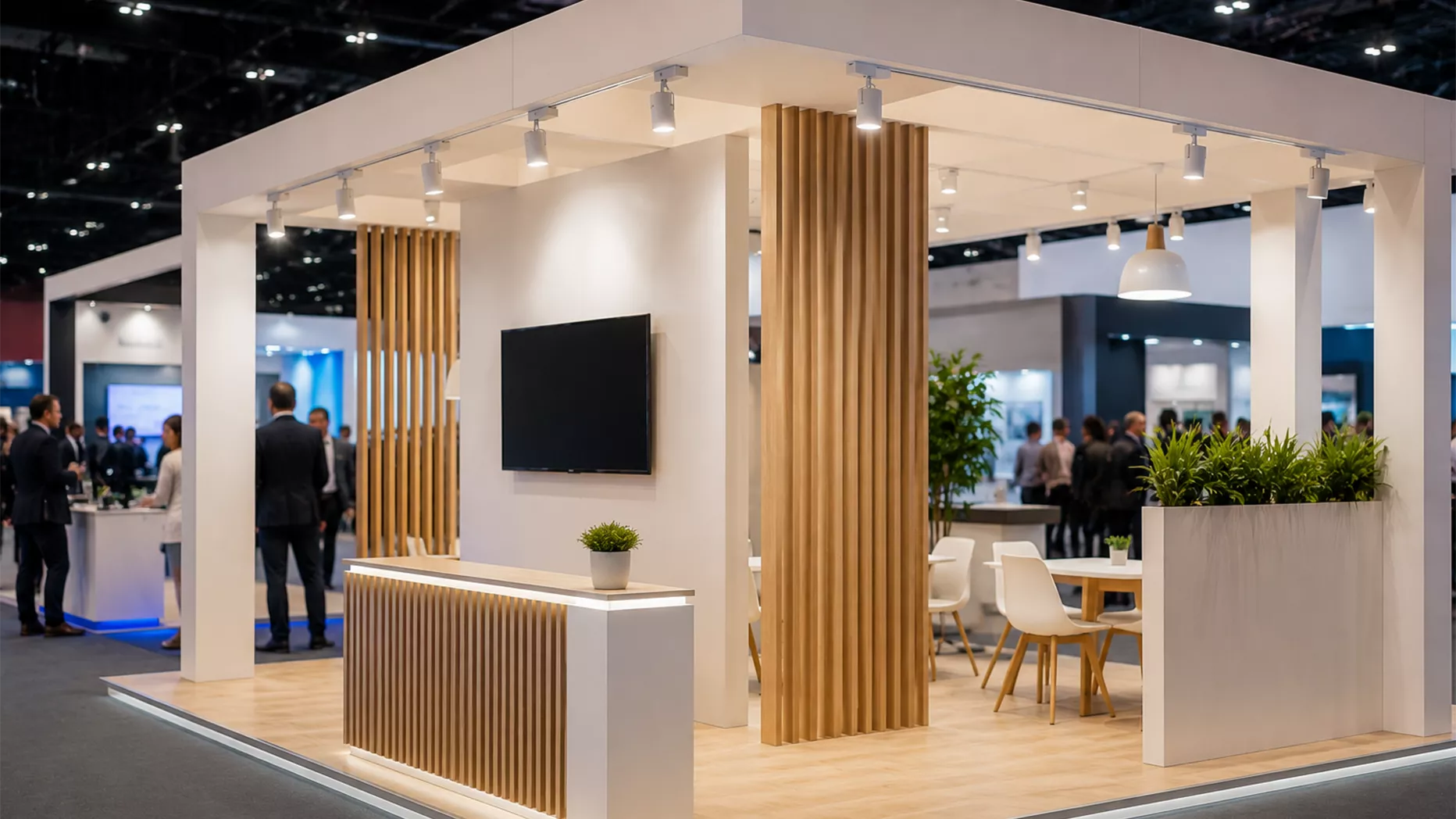
Buying an exhibition stand is capital expenditure in the UK; you claim capital allowances rather than deducting it as an expense. Full expensing gives companies a 100% first-year deduction. Renting a shell scheme is a revenue expense and fully deductible in the year. Choose by use case, not by tax.
UK exhibitors planning their 2026 trade show calendar at ExCeL London, NEC Birmingham, Olympia London, or Manchester Central usually treat the budget as one number. Stand, build, furniture, graphics, AV, all logged as marketing spend. For one-off rentals, that’s broadly fine. For exhibitors buying a reusable custom stand, it’s wrong, and it can quietly cost the business thousands in lost tax relief.
The tax treatment depends on a single question HMRC has been asking for years: Is this spending revenue or capital? Get the answer right and the tax bill drops by up to 25p in every pound spent. But if you get it wrong, the deduction either disappears or gets spread over the years.
Why The Tax Treatment Of Exhibition Stands Holds More Significance Than Most Exhibitors Realise
Most marketing teams book stand spend through the exhibition marketing budget and never speak to finance about it. The accountant sees the invoices at year-end, files them under trade show costs, and the matter ends there. For one-off shell scheme hire, that’s the right outcome: rental expense on an exhibition stand is tax deductible in the UK as standard revenue.
The problem starts when a company decides to buy a stand. A custom build for £40,000 looks identical on a cash flow forecast to four years of £10,000 hire bills. The accounting treatment is different. The tax treatment is different again. And nobody finds out until the accountant has the invoices and has to ask whether the stand is owned and whether the business plans to use it again.
A £40,000 stand purchase that qualifies for full expensing reduces taxable profits by £40,000 in the year of purchase. With corporation tax at 25% for UK businesses, that is £10,000 of tax saved upfront. The same £40,000 spent on four shell scheme hires across the year also saves £10,000 in tax, but only because it is fully expensed as revenue. Exhibitors get caught out in the middle ground: they buy a stand, treat the cost like a marketing expense, and the accountant has to unpick it at year-end. Sometimes the claim still goes through cleanly. Sometimes it doesn’t, and the relief gets spread over years instead of taken in one go.
This matters more for some exhibitors than others. A company hiring a 3m × 2m shell scheme once a year at Olympia London does not need to think about this. A company exhibiting four times a year across ExCeL London, NEC Birmingham and Manchester Central and considering a reusable custom build, does. So does any business making serious capital investment in owned AV, LED screens, lighting rigs, or modular exhibition stand systems that will travel across multiple shows.
If you’re weighing the tax position against the operational case, our piece on renting vs buying a trade show display covers the operational comparison in depth.
Revenue vs Capital: The Test HMRC Applies
The line between revenue expenditure and capital expenditure in the UK has been argued in tax courts for over a century. The principle is simpler than the case law: enduring benefit means capital. Day-to-day cost means revenue.
HMRC’s capital v revenue toolkit sets out the principle. Capital expenditure brings into existence an asset of enduring benefit to the trade. Revenue expenditure is the recurring cost of running the trade day-to-day. For exhibition stand spending, the capital expenditure vs revenue test usually splits cleanly.
When Exhibition Stand Spending is Revenue Expenditure
- Renting a shell scheme for a single show.
- Furniture hire for a specific event.
- AV hire for the show duration.
- Graphics printed for one show.
- Stand build labour and on-site services for a single event.
- Travel, accommodation, and on-stand staff costs.
These are fully deductible in the accounting period they’re incurred.
When Exhibition Stand Spending is Capital Expenditure
- Buying a custom exhibition stand designed for reuse.
- Purchasing modular stand components (panels, towers, counters, lightboxes) for repeated use.
- Buying LED screens, lighting rigs, or AV equipment that the business will own.
- Reusable display boards with a multi-year useful life.
- Stand storage cases and transport crates acquired alongside the stand.
These cannot be deducted directly. They are treated as a trade show asset and go on the fixed asset register, with the business claiming capital allowances rather than booking depreciation against taxable profits. Note that accounting depreciation on exhibition stands is not deductible for UK tax purposes; capital allowances replace it. Your accounting software will show depreciation in the P&L for management accounts; HMRC adds it back, and you claim capital allowances instead.
The Capital Allowances Available to UK Exhibitors in 2026
UK businesses buying qualifying plant and machinery in 2026 can choose from four main reliefs on the HMRC qualifying assets list. Most exhibitors will use the Annual Investment Allowance or full expensing; others apply in specific cases.
| Relief | Rate | Who qualifies | Annual limit |
| Annual Investment Allowance (AIA) | 100% first-year deduction | All businesses (companies, partnerships, sole traders) | £1 million per year |
| Full Expensing | 100% first-year deduction | Companies only (corporation tax) | No upper limit |
| 40% First Year Allowance | 40% first-year deduction | Unincorporated businesses and leased assets | No upper limit (since 1 Jan 2026) |
| Writing Down Allowance (WDA) | 14% per year, reducing balance (from April 2026) | Anything not covered by the above | N/A |
Annual Investment Allowance (AIA)
The Annual Investment Allowance gives a 100% first-year deduction on qualifying plant and machinery up to £1 million per year. It applies to companies, partnerships, and sole traders, and you can claim AIA on exhibition equipment that counts as plant and machinery. For most UK exhibitors buying a stand, the AIA is the simplest route.
Full Expensing
For companies within the charge to UK corporation tax, the full expensing scheme gives a 100% first-year deduction on qualifying main rate plant and machinery with no upper limit. Originally temporary, full expensing on exhibition stand expenditure was made permanent under the 2024 Corporate Tax Roadmap.
To qualify, the stand must be:
- New and unused (not second-hand).
- For use in your qualifying activity (trade).
- Main rate plant or machinery.
- Bought by a company within the charge to corporation tax.
Special rate expenditure, integral features, long-life assets, and certain electrical systems get a 50% first-year allowance instead.
The new 40% First Year Allowance
From 1 January 2026, a new permanent 40% first-year allowance is available for main rate plant and machinery that does not qualify for full expensing. This mainly benefits unincorporated businesses with spending above the £1m AIA limit, and businesses buying assets for leasing.
For most exhibitors buying a single stand under £1m, this relief is not relevant; the AIA covers it.
Writing Down Allowances
If expenditure does not qualify for AIA, full expensing, or the 40% FYA, you can claim writing down allowances. From April 2026, the main pool WDA rate is reducing from 18% to 14% per year on a reducing balance basis. WDAs replace accounting depreciation as the tax-deductible mechanism for spreading relief over the asset’s useful life.
Worked Example: Rental vs Purchase Tax Treatment Compared
Two UK companies, both exhibiting at four shows a year across ExCeL London and NEC Birmingham. Same shows, same budget, different approach.
Scenario A: Renting a Shell Scheme Each Year
- Four shows × £10,000 per show = £40,000 annual spend.
- All revenue expense fully deductible.
- Tax relief at 25% corporation tax = £10,000.
- Net cost after tax = £30,000.
Scenario B: Buying a Custom Stand
- One-off custom stand purchase: £40,000 (qualifies as plant and machinery).
- Stand reused for all four shows.
- Additional annual revenue costs: graphics refresh, transport, install labour, AV hire = £12,000.
- Year 1 tax position:
- Full expensing on £40,000 stand = £10,000 tax saved.
- Revenue costs of £12,000 fully deductible = £3,000 tax saved.
- Total Year 1 tax saving: £13,000.
- Year 2 onwards: only £12,000 annual revenue costs.
- Year 2 tax saving = £3,000 per year.
The purchase route delivers a bigger upfront tax saving and lower running costs from Year 2, provided the stand has a usable life of at least three to four years. Tied to exhibition ROI calculations, this is where capital allowances on exhibition stand purchases earn their keep.
The catch: a balancing charge applies on disposal. For full expensing claims, the charge equals the disposal proceeds, brought back into tax.
What Qualifies as Plant and Machinery (and What Doesn’t)
The HMRC Capital Allowances Manual at CA20006 sets out the broad definition. Plant and machinery covers a wide range of business assets, but not everything an exhibitor buys qualifies. The HMRC qualifying assets list is principle-based rather than a closed catalogue, so the test is whether the asset functions as apparatus used in the trade.
Typically qualifies as plant and machinery:
- Custom exhibition stands designed for reuse.
- Modular display systems (octa fabric, pop-up, modular panels).
- LED screens and AV equipment owned by the business.
- Lighting rigs and lighting equipment.
- Reusable display boards and freestanding graphic units.
- Counters, display cases, and demo plinths.
- Stand storage and transport cases.
Does not qualify:
- Show-specific printed graphics.
- One-use shell scheme hire.
- Build and dismantle labour.
- Floor space rental from the show organiser.
- Hospitality and catering.
- Land, buildings, or fixed structures.
The grey area is custom shell scheme builds, stands built for one show using modular panels the contractor reuses. If you buy the panels, they’re capital. If the contractor owns them and you hire the build, it’s revenue. The UK tax treatment of modular exhibition stand spend depends on the contract structure, not on what the stand looks like.
How to Decide: Rental, Purchase, or Hybrid
The tax treatment matters, but it should not drive the decision. Use case drives it. Tax efficiency follows:
Rental makes sense when:
- You exhibit at one or two shows a year.
- Each show has different stand requirements.
- You want predictable annual costs with no balance sheet impact.
Purchase makes sense when:
- You exhibit at four or more shows a year.
- Your stand design is stable for at least 2–3 years.
- You can fund the upfront outlay and want the full expensing benefit.
Hybrid makes sense when:
- You own core modular components but hire the build, graphics, and AV per show.
- You exhibit at varied venue sizes (ExCeL London, NEC Birmingham, Olympia London, Manchester Central) and need flexibility.
A company exhibiting four times a year and planning a £40,000 stand purchase can expect a £10,000 first-year corporation tax saving under full expensing. A company exhibiting once a year should not buy a stand just to claim the allowance.
Practical Steps for Exhibitors Buying a Stand
If you have decided to purchase, the tax claim becomes part of the process, not an afterthought at year-end.
Before the purchase:
- Confirm with your accountant whether full expensing or AIA suits your structure.
- Check if the stand qualifies as plant and machinery.
- Confirm the stand is a sale, not a long-term lease; leasing changes the treatment.
At the point of purchase:
- Get an invoice that separates capital items (the stand, modular components) from revenue items (one-off graphics, build labour, transport).
- Record the asset on your fixed asset register in your accounting software, with the acquisition date, cost, and expected useful life.
During and after:
- Keep records of every show where the stand is used.
- Account for refurbishments separately; improvements may be capital, and repairs are usually revenue.
- On disposal, apply the balancing charge; for full expensing claims, this equals 100% of the disposal value.
For a deeper look at how to structure rental, purchase, or a mix of both across your show calendar, our guide on building your exhibit strategy rental purchase or hybrid covers the full framework.
A Word Before You Sign
Exhibition stand spend is one of the easier areas of UK corporation tax to get right, once you know the line between capital and revenue. The reliefs are generous, the qualifying assets list is broad, and full expensing on plant and machinery is now a permanent fixture of the system rather than a temporary measure. For UK companies exhibiting regularly at ExCeL London, NEC Birmingham, Olympia London, or Manchester Central, that adds up to real money saved, provided the purchase is structured properly from the start.
The mistake exhibitors make is not claiming the wrong relief. It is not asking the question in the first place. The £10,000 of corporation tax saved on a £40,000 stand purchase only gets claimed if someone in the business knows to claim it before the year-end accounts are filed.
If you’d like to discuss the trade-offs between shell scheme hire, modular ownership, or a full custom build, and want a supplier who can structure invoices cleanly for capital allowance purposes, we’re happy to talk it through. At EMS Exhibitions, we work with UK exhibitors at ExCeL London, NEC Birmingham, Olympia London, and Manchester Central across all three models.
Call us on 020 7820 8006 or email us at [email protected].
Frequently Asked Questions
1. Can I claim capital allowances on a trade show stand in the UK?
Yes, if the stand qualifies as plant and machinery and is bought (not hired). Custom and modular stands designed for reuse generally qualify. One-use shell scheme hire does not; that is a revenue expense.
2. What’s the difference between rental expense and capital expenditure for exhibition stands?
Rental expense on an exhibition stand is tax-deductible in the UK as standard revenue, fully written off in the year. Buying is capital expenditure, with relief claimed through capital allowances. Most companies get a 100% first-year deduction under full expensing or the Annual Investment Allowance.
3. Does the full expensing scheme apply to exhibition stand purchases in 2026?
Yes. Full expensing on exhibition stand expenditure was made permanent under the 2024 Corporate Tax Roadmap. UK companies within the charge to corporation tax can claim 100% of qualifying expenditure in the year incurred.
4. What about the new 40% first-year allowance from 1 January 2026?
The 40% FYA mainly benefits unincorporated businesses with capital spending above the £1m AIA limit, and businesses buying assets for leasing. Most companies will use AIA or full expensing instead.
5. Can I claim the Annual Investment Allowance on exhibition equipment?
Yes. Exhibition equipment that qualifies as plant and machinery, such as modular stands, LED screens, lighting, and reusable display boards, falls within the AIA. The annual limit is £1 million per business.
6. Should I take tax advice before deciding?
Always. The rules vary depending on business structure, accounting period, and the specific nature of the stand. Speak to your accountant before claiming.