
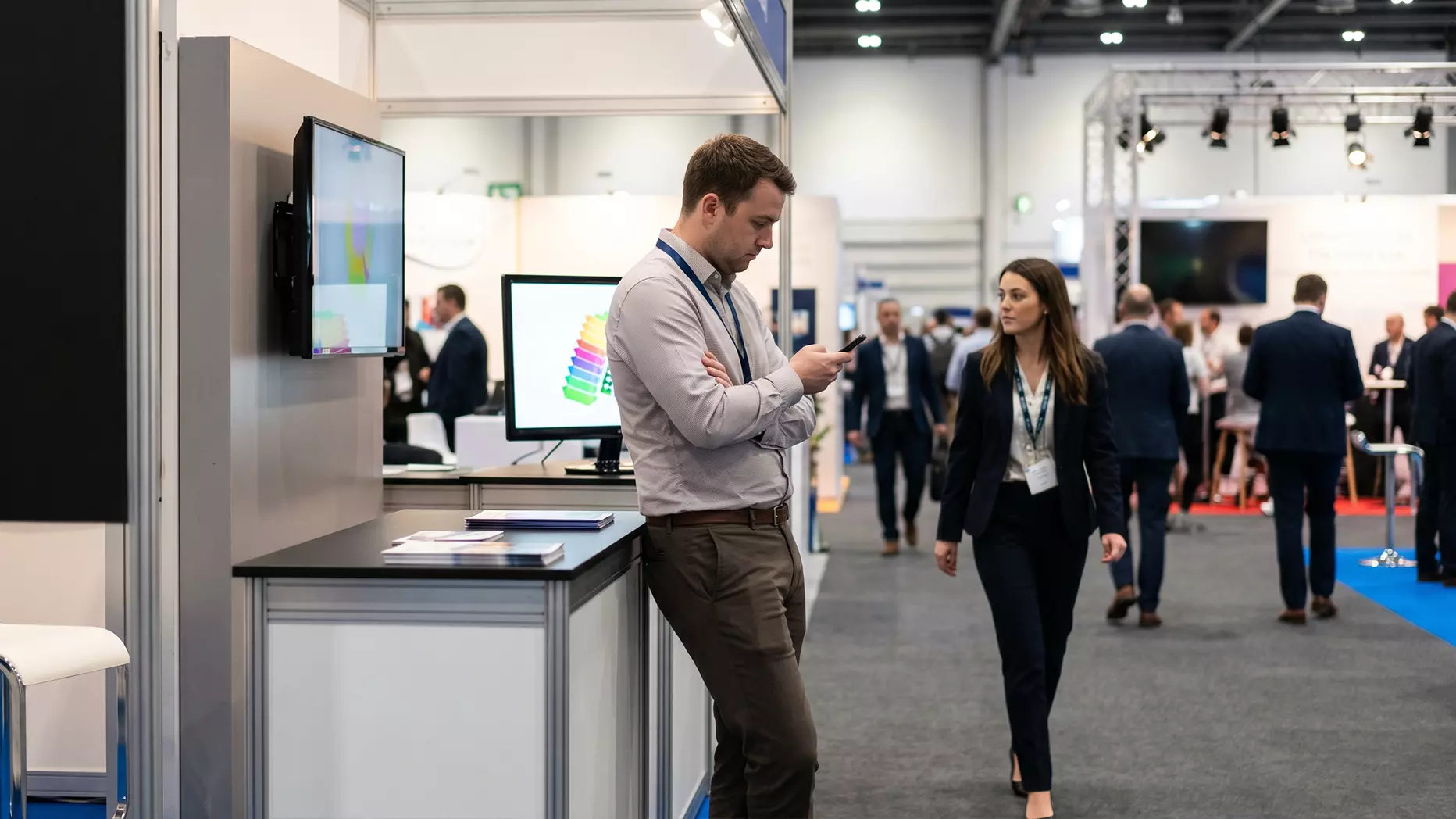
Visitors decide whether to stop in 2 to 3 seconds, and posture, eye contact, and hand position settle it before a word is said. UK exhibitor teams lose leads to phones, folded arms, and bad greetings. Fix the seven mistakes inside.
Exhibitor staff body language decides more conversations than the stand itself. Visitors walking the aisle at NEC Birmingham or ExCeL London read posture, eye contact, and hand position before they read graphics. By the time they’re close enough to talk, they’ve already chosen whether to stop. Most UK exhibitor teams don’t realise this is happening, and the closed signals that their bodies send during a long show day quietly turn footfall into passing footsteps.
The patterns repeat across every UK exhibition floor. Crossed arms during a quiet hour. Two staff in conversation with their backs to the aisle. A phone held at chest height “just for a second”. Each one is small. Together, they reshape how the stand reads to a passing visitor, and the cost is measurable in lost leads.
The Two-to-Three-Second Window
Research consistently shows that first impressions form within seconds. A widely cited study from Princeton found that judgements about trustworthiness, competence, and likeability are made in roughly 100 milliseconds and rarely change with longer exposure. On a busy exhibition floor, with hundreds of stands competing for the same eyes, that window narrows further. Visitors filter quickly because they have to.
Studies on non-verbal communication, including the often-quoted research by Albert Mehrabian, place body language and tone well above spoken content in early impressions, particularly when emotion or intent is being judged. The exact percentages get stretched online, but the underlying point holds: posture, eye contact, and facial expression are doing the early work, before the first word lands.
This makes stand presence a higher-leverage variable than most exhibitors treat it as. The build is fixed once installed. Travel and accommodation are sunk costs. The only thing left to influence return on investment on the day is what your team does with their bodies.
The Body Language Mistakes UK Exhibitor Staff Make Most Often
Here are some of the most repeated and noticeable mistakes exhibitor staff make that leave an impression before they utter a word.
1. Standing Behind The Counter All Day
The counter is a barrier. Staff who stay behind it for the whole day signal “I work here, you’re a customer”. Visitors slow down less.
Instead, do stand in front of or beside the counter, at the edge of the stand, facing the aisle. Use the counter for taking notes during a conversation, not as a base.
2. Talking To Colleagues With Backs To The Aisle
Two staff members in conversation form a closed circle. Visitors read closed circles as private and walk past.
Instead, when nothing is happening, split up and face outward. If something needs discussing, take it to the back of the stand or off the floor entirely.
3. Phones At Chest Height
Checking emails on a stand looks identical to scrolling social media from a passing visitor’s view. Either way, you have signalled you’re busy with something more important than them.
Simply keep your phones in your pockets between conversations. If a reply genuinely cannot wait, step off the stand to send it.
4. Folded Arms, Hands in Pockets, or Hands Clasped Low
Folded arms read as defensive. Hands in pockets read as bored. Hands clasped at the waist, the fig leaf position reads as nervous.
The best practice is to keep your hands visible. At your sides, holding a tablet or holding a brochure, all work. It feels unnatural for the first hour and becomes a habit by lunch.
5. Eating, Drinking, or Chewing on Stand
Water at the back of the counter is fine. Coffee in hand while greeting someone, sandwiches, crisps, or chewing gum are not.
Eat off the stand during your rotated break. Hot drinks belong off the floor.
6. Sitting During Peak Hours
A perch stool at the back is reasonable for quiet windows. Sitting during the morning rush at a London tech show puts visitors above you in the conversation, which weakens the dynamic from the start.
Stand during the peak hours. Use the stool only when the aisle is genuinely quiet.
7. Greeting with “Can I Help You?”
Don’t ask any closed yes/no questions. The easy answer is “No, just looking”, and they keep walking.
Instead, open with something visitors can engage with. “First time at the show?” or “Anything in particular caught your eye?” keep the conversation open without forcing a decision.
What Good Stand Presence Looks Like
The cues are specific and trainable:
- Feet pointing toward the aisle, weight even.
- Shoulders back without being rigid.
- Hands visible at sides, holding a tablet, or gesturing while speaking.
- Eyes scanning at face level, not at badges or the floor.
- A small genuine smile that comes and goes, not a fixed grin.
- When a visitor slows, a square turn to face them.
- Half a beat of pause before the first line.
- Nodding while they explain, not interrupting.
These are small adjustments. None are difficult on their own. The challenge is holding them consistently across an eight- or nine-hour day, which is where most teams fail without a structured rotation.
Fatigue Is The Real Enemy Of Stand Presence
The Center for Exhibition Industry Research has consistently shown that staff energy drops sharply after the four-hour mark on busy show floors, and that the final two hours of each day produce the lowest engagement quality. The shoulders drop, the smile fades, and the phone returns. By 4 pm, half the stands in the hall look closed even though they’re technically open.
The fix is structural, not motivational. Telling people to “stay energetic” doesn’t hold past lunch.
Three-Person Team Rotation
For a single shell scheme stand or small custom build, the workable pattern is:
- One person on the front edge, engaging passers-by.
- One person at the counter, handling visitors who have stopped.
- One person on a proper break, off the floor entirely, ideally outside the hall.
Rotate every 45 minutes. Each person gets roughly 90 minutes off the front edge before returning to it.
Two-Person Team Rotation
If you only have two staff, accept that the stand will be unmanned for short windows. A “back in 10” sign is better than two exhausted people staring blankly at the aisle.
Multi-Day Shows at NEC Birmingham, ExCeL London, or Manchester Central
For three- and four-day exhibitions, bring more staff than feels necessary. The cost of an extra pair of hands across four days is small compared with the lost leads from a tired team in the final two hours of each day. This is particularly true at the NEC, where the hall floor is large enough that fatigue compounds across the distance walked between conversations and breaks.
For the staffing ratios, briefing structure, and rotation logic that match your stand size, our recommendations for successful trade show booth staffing cover the full framework.
Greeting Visitors at UK Trade Shows
UK exhibitions have a specific cultural baseline. British visitors don’t respond well to American-style high-energy greetings. “Hi! How are you doing today?” lands as overdone in a Birmingham hall and pushes people away.
What works at UK shows:
- A small nod and brief eye contact as someone slows down.
- A short, neutral opener, like “Morning. Any questions about what we do?”
- Enough warmth to feel welcoming, not so much that it feels rehearsed.
- Energy that matches the visitor, then about 10% above.
International shows in London shift this slightly. Audiences with a heavier international mix accept warmer greetings. Read the room and calibrate.
Body Language Differs By Stand Type
The fundamentals stay the same across every UK exhibition, but the way they play out depends on the build. A 3m × 2m shell scheme demands different staff discipline from a 50 m² custom stand with a meeting room, and training a team without accounting for the difference is where most exhibitors lose ground on the day.
Shell Scheme Stands
On a 3m × 2m shell scheme, your team is roughly 80% of what visitors see. There’s nowhere to hide a slumped posture or a phone-checking habit. Discipline has to be tighter, and breaks must be taken off the stand entirely because there is no back-of-house. Octa fabric shell schemes give you a clean canvas, but staff posture is still the dominant visual.
Custom Exhibition Stands
Larger custom builds give you more room to manage energy. Tired staff can rotate to a back area, refresh, and return. Conversations can move from the aisle edge into private meeting space, which changes the body language requirements. Interactions become softer, more seated, and more listening-led.
If your custom stand has dedicated meeting rooms or a soft-seating area, train the team on the handover from aisle to private space. Don’t rush the visitor. Don’t crowd them. Let them sit first, offer water, then start the conversation. The transition itself is part of the impression.
The right stand layout makes good body language easier to maintain. Open-fronted shell schemes pull staff toward the aisle naturally. Stands with integrated meeting space, soft seating from professional event furniture hire, and clear sightlines reduce the temptation to retreat behind a counter or huddle in a corner.
Pre-Show Training: An Hour the Week Before
Most UK exhibitors brief staff on product features and pricing, then expect everything else to take care of itself. It doesn’t.
A short pre-show session covers what’s missing. One hour, the week before the show.
Cover in the session:
- The seven body language mistakes above, with quick role-plays.
- Two practice greetings each, said out loud.
- A 20-second engagement drill: one person plays a sceptical visitor, and the other has 20 seconds to start a real conversation.
- Where do bags go on the day?
- Where lunch is taken and who covers the stand for it.
- Who handles loo breaks and how the rotation actually works.
- Who is the named lead for hot prospects?
- How leads are captured (paper, tablet, or app, but agree one system).
The session feels awkward in the room and saves enormous awkwardness on the show floor.
On-Stand Checklist for Staff
Print this and stick it on the back of the counter where visitors can’t see it. Brief the team off it on day one before doors open.
- Phones in pockets.
- Feet pointing toward the aisle.
- Hands visible, open or holding a tablet.
- One person on the front edge at all times.
- No eating or drinking on the stand except water at the counter.
- Greet within five seconds of someone slowing down.
- No “Can I Help You?”
- Listen for twice as long as you talk.
- Write down one specific thing about each visitor for follow-up.
- Rotate breaks every 45 minutes, even when busy.
By day two, most of this becomes habit.
What Strong UK Exhibitor Teams Do Once Body Language Is Right
Body language gets a visitor onto the stand. What happens next decides whether they remember you three days later.
The teams that consistently win at UK shows write the visitor’s name and one specific detail from the conversation onto the lead form, in front of the visitor. That detail, the project they mentioned, the deadline they’re working to, the colleague they referenced, is what makes the follow-up email feel personal instead of templated.
This is where good stand presence converts into real pipeline. For more on what those follow-up moments should look like, our piece on how to build credibility and connections at trade shows covers the post-conversation work in depth.
Speak To Our Team
If you’d like to talk through stand layouts, staffing structures, or rotations that make consistent body language easier to hold across a full UK show day, our team at EMS Exhibitions is happy to help. We’ve worked with exhibitors at every UK venue from ExCeL London to NEC Birmingham and Manchester Central, and we know what the floor demands of a team.
Call 020 7820 8006 or email [email protected]
Common Questions About Exhibitor Staff Body Language
1. How long do you have to make a first impression at a trade show?
Two to three seconds from the moment a visitor sees your stand. Body language fills that window before any conversation begins.
2. What’s the best opening line for greeting visitors?
Anything except “Can I help you?” works better. “First time at the show?” and “Anything in particular caught your eye?” both keep the conversation open.
3. How many staff should be on a shell scheme stand?
Three is the practical minimum for a full day at NEC Birmingham or ExCeL London. One on the aisle, one at the counter, one on rotation. Two-person teams work for shorter shows but require stricter discipline.
4. Should staff sit on a trade show stand?
Not during peak hours. Standing keeps the visitor on the same level and signals readiness. Use a perch stool only in genuinely quiet windows.
5. How often should staff rotate breaks?
Every 45 minutes. Shorter intervals don’t allow proper recovery; longer ones let fatigue compound visibly in posture and engagement quality.
6. Does body language matter more on small stands or large ones?
Small. On a 3m × 2m shell scheme, staff are 80% of what visitors see. On a larger custom build, the stand carries more of the visual weight, but staff still set the tone for every interaction.